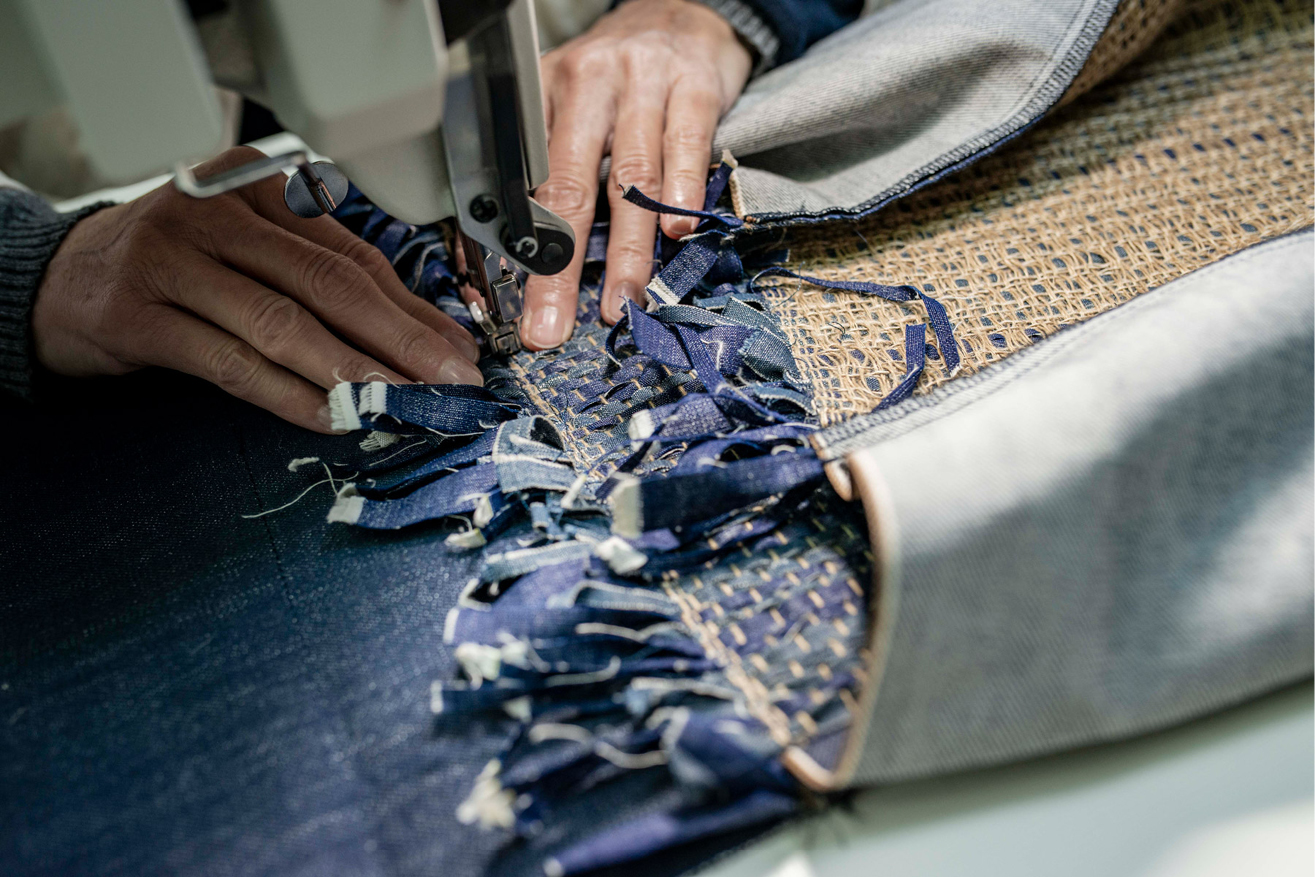
Why this craft matters now in textile industry
The resurgence of craftsmanship responds to deep shifts within the fashion and textile industry. In an era dominated by digital imagery and mass-standardization, end users and brands alike seek tactility, depth, and meaning. Handmade irregularities, textural variations, and human-made imperfections become markers of value and identity.
Furthermore, many craft techniques, such as hand weaving, natural dyeing, resist dyeing, zero-waste cutting, naturally align with circularity and reduced environmental footprint, responding to the growing demand for responsible sourcing.
It is clear that craft is a bridge between past and future. It safeguards cultural identities and supports artisan communities whose knowledge, transmitted through generations, is increasingly recognized as a strategic form of intangible heritage.
Furthermore, brands like Bottega Veneta, Prada, Balmain, and others are integrating artisanal codes and interventions into hybrid aesthetics: 3D textures, macramé and crochet, natural dye effects, tactile weaves, handcrafted details, and handloom weaving, offering the public renewed contemporary silhouettes to enrich the material culture and product narrative.
The importance of craft in contemporary design
The resurgence of craftsmanship responds to deep shifts within the fashion and textile industry.
First of all, fashion market is asking for authenticity and material storytelling: in an era dominated by mass-standardization, end users and brands alike seek tactility, depth, and meaning. Handmade irregularities, textural variations, and human-made imperfections become markers of value and identity.
The second point is about sustainability and low-impact production. Many craft techniques, such as hand weaving, natural dyeing, resist dyeing, zero-waste cutting, are naturally align with circularity and reduced environmental footprint, responding to the growing demand for responsible sourcing. Thanks to their responsible qualities, artisanal techniques are emerging and finding space in the latest productions and capsule collections.
Another fundamental aspect concerns the conservation and valorization of cultural heritage, because craft is a bridge between past and future.
Furthermore, technology is increasingly integrated with craftsmanship to support slow fashion and more circular processes, giving rise to a hybrid aesthetics in fashion design. Craft is no longer positioned in opposition to technology. Instead, its tactile language blends with digital design tools, 3D modeling, AI pattern development, and advanced textile engineering.
Brands such as Prada, Isabel Marant, Chanel, and others are integrating artisanal codes into contemporary silhouettes: 3D textures, natural dye effects, tactile weaves, hand-loom weaving, hand-crafted leather details to enrich material culture and product storytelling.
The craft techniques shaping the future of fashion
> Shibori:
Shibori is an ancestral Japanese resist-dye technique based on folding, binding, compressing, or stitching the fabric before dyeing. The result is a unique organic pattern, always different, always expressive.
Why it matters today
- inherently zero-waste
- compatible with natural dyes (like indigo)
- visually rich and highly customizable
- ideal for premium capsules and artisanal-inspired collections
> Tie Dye:
Tie-dye is a more modern, Western, and often casual version, popular in the 1960s, that relies on looser knots and pleats for abstract, psychedelic results, often using reactive dyes.
Why it have significance in design
- expressive and contemporary
- scalable craft aesthetic
- versatile across materials and categories
- ideal for upcycling, overdyeing, and stock revalorization
> Batik:
Batik, practiced across Indonesia, West Africa and beyond, is based on applying hot wax to create resist areas before dyeing. Each step builds complexity, depth, and meaning.
Why it’s back
- symbolic and culturally rich patterns
- organic textures aligned with current design codes
- adaptable to modern color palettes
- hybrid digital-craft workflows (manual patterns scanned for digital printing or jacquard interpretation)
> Hand-Loom Weaving:
Hand-loom weaving is one of the oldest methods of textile construction and it is experiencing a renewed relevance across the textile supply chain.
Why it’s growing
- brings uniqueness, tactility, and visual depth
- supports transparent and local supply chains
- offers high-value fabrics for luxury and premium markets
- integrates seamlessly with digital design tools (pattern development, yarn simulation, jacquard files)
How fashion is reinterpreting it
- textured surfaces inspired by kilims, Andean, African or Indian weaving traditions
- natural fibers such as organic cotton, linen, hemp, and regenerated wool
- limited-edition artisanal fabrics for runway and elevated RTW collections
Hand weaving represents one of the strongest bridges between tradition and textile innovation.
> Upcycling
Upcycling has evolved from a niche creative movement to a key design strategy for fashion brands and suppliers moving toward more responsible, circular production. Transforming existing materials into new creations reduces impact and unlocks a powerful aesthetic identity.
Why it matters
- reduces waste across the supply chain
- transforms leftover materials into high-value products
- fits denim, knitwear, leather goods, and garment-dye industries
- encourages unique patterning through patchwork, mending, overdyeing, and hybrid craft techniques
Brands increasingly experiment with:
- reworked denim and deadstock
- patchwork constructions
- reconstructed knitwear
- hybrid materials combining old and new
Upcycling is contemporary craftsmanship: expressive, responsible, and materially intelligent.
Strategic Opportunities for Brands, Mills, and Producers
For textile manufacturers, craft represents an opportunity to expand both creative and technical horizons. Developing craft-inspired capsules and specialty fabrics allows mills to differentiate their offer, while experimenting with natural dyes, low-impact finishing, and textural weaves helps align innovation with sustainability. Collaborations with artisans and craft specialists can further enrich the design vocabulary, opening new paths for material experimentation and storytelling.
For denim mills and laundries, craft techniques offer a valuable framework to rethink surface design and finishing processes. The logic of Shibori, for example, can be translated into laser applications or engineered treatments, while eco-washing processes can be used to create craft-inspired textures and irregularities. Exploring natural indigo, overdyeing, and hybrid dyeing methods adds depth and authenticity to denim collections, while upcycling can evolve through engineered repair and reconstruction techniques that elevate waste reduction into a design-driven approach.
For fashion brands, craft becomes a powerful strategic asset in building identity and emotional connection. Authentic storytelling around materials and processes helps communicate value beyond aesthetics, while highlighting tactile, hand-built elements reinforces the perception of quality and uniqueness. Designing through a hybrid analog–digital approach allows brands to merge artisanal sensibility with contemporary tools, creating collections that are both rooted in tradition and aligned with the future of fashion.
Ultimately, craft is not a decorative choice but a strategic one. It elevates design, strengthens brand identity, and responds to a growing demand for fashion that is meaningful, responsible, and deeply connected to human expertise.
The future of textiles and of fashion belongs to those who can merge heritage and innovation, where human expertise and digital intelligence co-create the next generation of materials and design.
Want to dive deeper into craft techniques?
In our latest articles, we’ve explored in detail the power of artisanal practices, such as Shibori and handloom weaving. To learn more, click on these links: